What a Support Vehicle Actually Does on a Ladakh Motorcycle Expedition
Quick Answer: What the Backup Vehicle Does
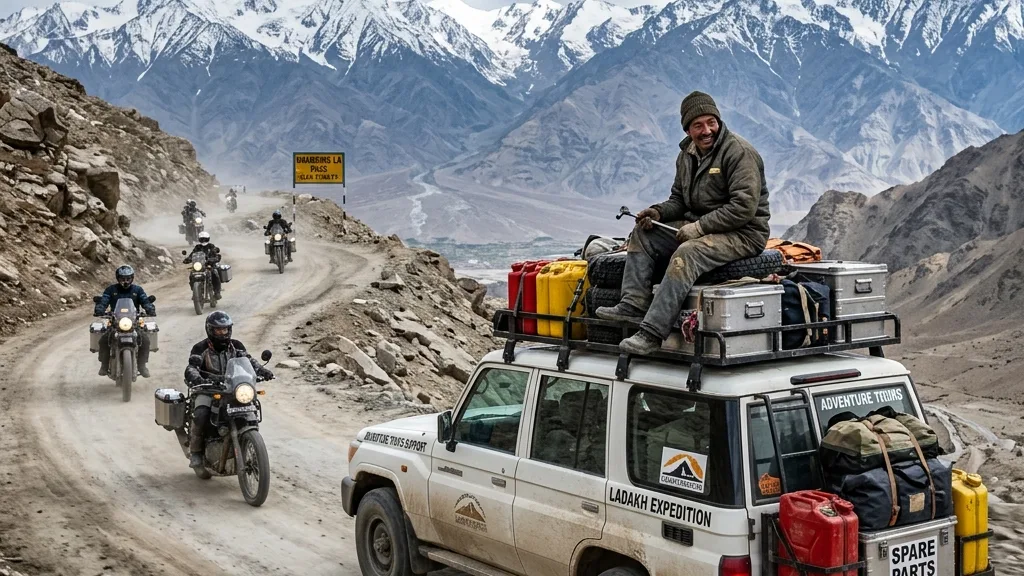
A dedicated support vehicle on a Ladakh expedition carries the group's luggage, spare fuel, spare parts, tools, an oxygen cylinder, an emergency medical kit, water and recovery gear, and travels the same route as the riders rather than meeting them at fixed points. It exists for four situations: a motorcycle that stops working, a rider who cannot continue, weather or a closure that forces a change of plan, and the long remote legs where there is nothing at the roadside to buy. It is not a medical service, and it is not a chase car sitting on your rear wheel all day.
Every Ladakh operator advertises a backup vehicle. Very few explain what it does, which is a shame, because it is the single component that most changes what an expedition feels like — and the one riders are most often quietly sceptical about. Here is the honest version, from the person who loads it.
It Is a Rolling Workshop, Warehouse and Fallback
Think of the vehicle as three things at once. It is the warehouse that takes the weight off the motorcycles, the workshop that keeps six bikes running at altitude for ten days, and the fallback that turns a serious problem into an inconvenience. Riders notice the first one immediately, the second by about day four, and the third only if something goes wrong — which, over a long enough season, it does.
What Is Actually In It
| Load | Why it is there |
|---|---|
| The group's luggage | A bike carrying panniers, a duffel and a tank bag handles like a different motorcycle on gravel. Riding light is not a comfort upgrade; it is a handling and fatigue decision. |
| Spare fuel in jerry cans | Ladakh has legs where the gap between working pumps exceeds a loaded bike's safe range. The cans exist so nobody is rationing throttle at altitude. |
| Spare parts and tools | Levers, cables, tubes, a chain, filters, bulbs, fluids and the tools to fit them at the roadside. Parts for the specific bikes on the trip, not a generic box. |
| Oxygen cylinder and emergency medical kit | Altitude symptoms escalate fastest in the first days. Oxygen buys time and comfort while the group descends, which is the actual treatment. |
| Water, food and warm layers | Some legs have nothing at the roadside for hours. Weather at 5,000m does not consult the forecast. |
| Recovery gear | Tow strap, basic traction help, and the ability to load a motorcycle when one genuinely cannot continue. |
Where It Is During a Normal Day
This is the part riders most often get wrong before their first supported trip. The vehicle is not glued to the back of the group, and you are not riding in a convoy with a truck in your mirrors. On a normal day it leaves with or shortly after the riders, runs the same route at its own speed, and turns up where the group stops. The driver knows the day's route and the day's end point, and the group and the vehicle stay in touch as signal allows.
On a self-guided expedition, where riders are deliberately spread out and setting their own pace, this matters more, not less. Nobody is waiting for the vehicle and the vehicle is not waiting for anybody — it is simply moving along the same line, so that whenever it is needed it is minutes away rather than a day away.
The Four Situations It Earns Its Keep
- A motorcycle stops. Most failures on a ten-day Himalayan trip are small: a cable, a puncture, a lever after a slow drop, a fouled plug. With a mechanic and the right box on the road, these cost twenty minutes. Without them they cost a day and a recovery charge, if a recovery is even available.
- A rider cannot continue. Altitude, a stomach that turns, a hard day in the wind, or an off that leaves somebody sore but intact. The rider gets in the vehicle, the motorcycle gets loaded or ridden on, and the expedition carries on to where it was going anyway.
- The plan changes at seven in the morning. A pass is closed, a track is washed out, an order has come down overnight. With luggage, fuel and beds already mobile, the group can take a different line the same morning instead of losing the day.
- The long empty legs. There are stretches here with no fuel, no food and no shelter for hours. On those days the vehicle is not insurance; it is the reason the leg is comfortable at all.
Can It Carry a Motorcycle?
Yes — one. A 4x4 pickup with a proper bed will take a single adventure motorcycle, which is the case that matters: a machine that has genuinely stopped, in a place where leaving it is not an option. It is worth being precise about this, because "backup vehicle" is sometimes sold as though it means the whole fleet can be trucked out at once. It does not. One bike, recovered properly, while the rest of the group keeps riding.
What It Is Not
A support vehicle is logistical and mechanical support. It is not an ambulance, and carrying oxygen and a first-aid kit is not the same as providing a medical service or medical evacuation. In a genuine medical emergency, what the vehicle gives you is a fast descent to lower altitude and a local team that knows exactly where the nearest real help is — which, at 5,000m, is worth a great deal, and is still not a hospital. Every rider should carry travel and medical insurance that explicitly covers motorcycling and high-altitude travel.
Why the Vehicle Choice Matters
A comfortable highway SUV is the wrong tool. What an expedition needs is a high-clearance 4x4 with a load bed: something that can carry weight, take a beating on broken surface, ford what the motorcycles ford, and still have space to put a bike in the back. That is why working vehicles like the Bolero Camper are the standard here rather than anything more luxurious — the vehicle is equipment, and it is chosen the way the rest of the equipment is chosen.
The other half of the choice is the driver. A driver who has run these roads for years reads a surface, a weather change and a military convoy the way the riders read a corner. On the days something goes wrong, the driver is frequently the most useful person in the group.
One Vehicle, One Group
The last thing worth asking any operator: is the vehicle dedicated to your group, or shared? A shared vehicle serving two trips is somewhere else when you need it, and its schedule, not yours, decides where it is. On a private expedition the vehicle belongs to the group for the whole trip, which is the only arrangement under which the four situations above actually work.
Read More
Safety Advisory
Road conditions in Ladakh fluctuate daily due to stream crossings, landslides, and weather. Always consult local checkpoint officers or message our Leh base camp for real-time conditions before leaving Leh.
Need a Reliable Ride?
Rent a specialized Royal Enfield Himalayan with full mounting gear from Leh Base Camp.
Browse Bike RentalsJoin A Guided Tour
Ride with expert guides, backup support trucks carrying oxygen cylinders, and mechanics.
View Guided ToursRelated Articles
- Self-Guided Ladakh Motorcycle Expedition: Ride Your Own GPX Route, With Support Behind YouSeptember 6, 2026
- Sending Us Your GPX Route for Ladakh: What We Check Before You Ride ItSeptember 6, 2026
- Royal Enfield Himalayan 450 vs 411: Which We Rent, and WhyMay 12, 2026
- Leh–Siachen–Leh 9-Day Motorcycle Expedition: Complete Rider's Guide 2027June 10, 2026